The u-blox ANNA-B5 series helps simplify wireless IoT development with a compact, highly integrated solution designed for today’s connected devices. Combining advanced connectivity, robust security, and flexible development options, the ANNA-B5 family enables engineers to quickly bring innovative products to market across smart home, industrial, healthcare, and consumer applications.
Paired with the EVK-ANNA-B5 evaluation kit, developers can streamline prototyping, accelerate design cycles, and confidently move from concept to deployment.

EVK-ANNA-B5 from u-blox
The EVK-ANNA-B50 evaluation kit provides a versatile development platform for the ANNA-B50 series modules, for quick prototyping of a variety of low-powered Internet of Things (IoT) applications supporting Bluetooth® Channel Sounding, and 802.15.4-2020 standards such as Thread®, Matter™, and Zigbee®.
The stand-alone ANNA-B50 module, included in the kit, is based on the Nordic Semiconductor nRF54L15 chipset, which features an Arm® Cortex®-M33 microcontroller with scalable memory configurations of 1.5 MB non-volatile memory (NVM), up to 256 kB RAM, and 128 MHz system clock. All features supported in the ANNA-B50 series modules are easily accessible from the Evaluation Kit (EVK).
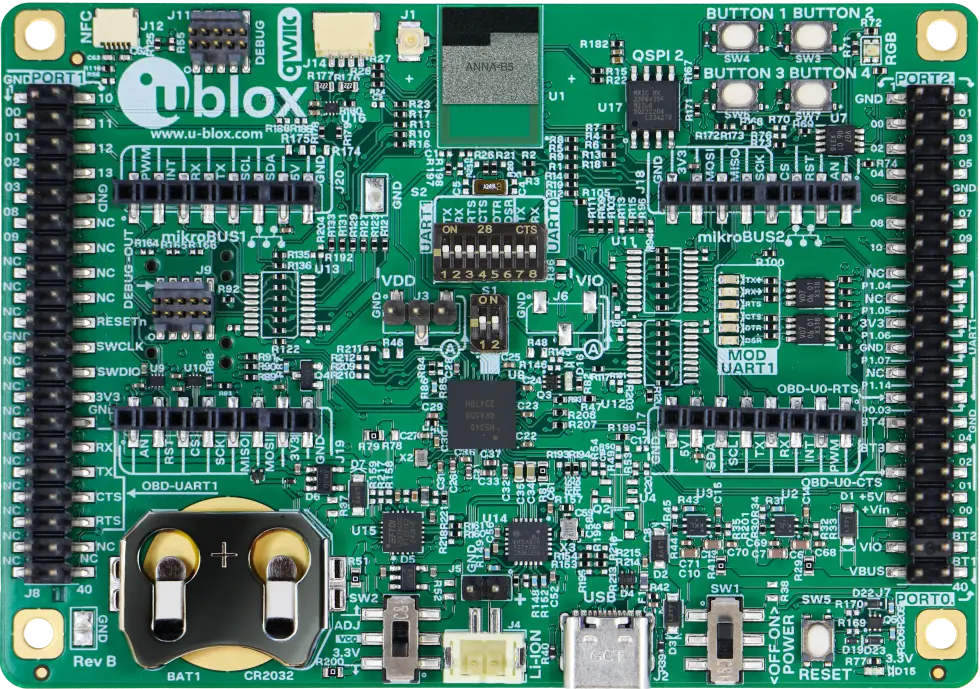
KIT INCLUDES
- Evaluation board with ANNA-B505 module (for evaluation of both ANNA-B501 and ANNA-B505)
- USB-C to USB-A cable
- NFC antenna
Applications
- Industrial automation
- Advanced wearables
- Smart buildings and cities
- Low-power sensors
- Wireless-connected and configurable equipment
- Point-of-sale
- Medical and health devices
- Real-time Location, RTLS
- Indoor positioning
- Asset tracking
- Wearables
Key Features
- Evaluation board for evaluation of ANNA-B501 or ANNA-B505 modules
- Module supply voltage of 3.3 V or 1.8 V
- COM ports and debug ports over USB
- 32x GPIOs accessible on pin sockets and test points
- An on-board SEGGER J-link OB programmer/debugger, with external Debug-out option
- Buttons and status LEDs for user interaction
- 2x mikroBUS™ compatible pin sockets.
- SOIC-8 external flash memory
- 32.768 kHz crystal
- USB peripheral connector
- Power input through USB-C, pin sockets, Li-ion, or coin cell battery
- Current measurement access points from pin headers and jumpers
- NFC connector
- QWIIC® connector through level shifter
Block Diagram
Figure 2 shows the major interfaces and internal connections supported on the EVK

