Solid-State Circuit Breakers

Smarter, faster and safer than traditional mechanical breakers
Advancements in Circuit Breaker Technology Using SiC JFETs

Advancements in Circuit Breaker Technology Using SiC JFETs

The latest trend in circuit protection replaces electromechanical relays with semiconductor power devices, known as solid-state circuit breakers (SSCB). These SSCBs offer numerous advantages. Semiconductor switches connect and disconnect without producing arcs, eliminating the need for arc-suppression features. Wide bandgap (WBG) devices – such as onsemi’s SiC JFETs – offer superior material properties, allowing power devices to operate at higher voltages, temperatures and switching rates.

Silicon Carbide JFETs  from onsemi

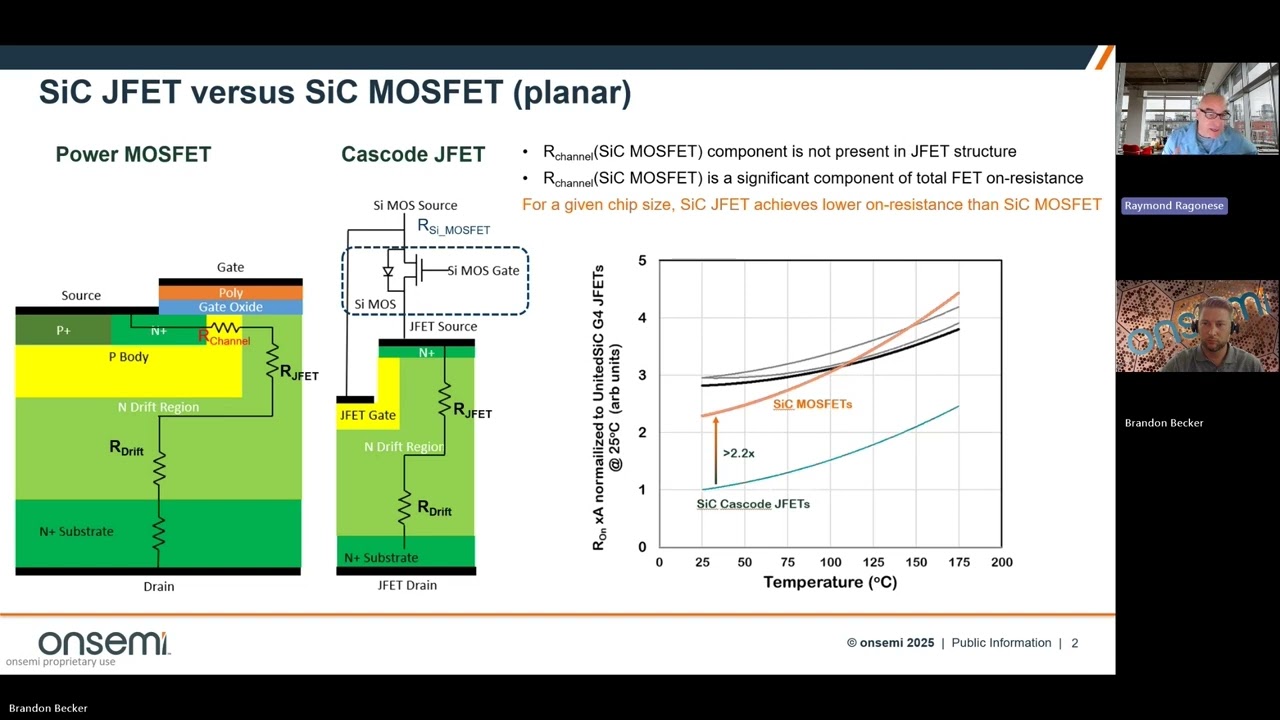
Junction field effect transistor (JFET) is a type of unipolar transistor, so it only uses majority carrier type. It is similar to MOSFET as it is operated on the electric field principle, it is voltage controlled and does not require biasing current. The main difference between the two of them is that JFET is a depletion-mode device (normally on) and requires reverse bias to switch and remain off. While some semiconductor-relay applications benefit from this normally-on state, most require a default normally-off state. Addition of a few components can create a normally-off switch even without applied power.
 

SiC JFET

  • Normally-on SiC JFET
  • Lowest available RDS on
  • VGS in on-state directly proportional to
    Tj → ideal self-monitoring power device
  • 1700 V, RDS(on) … 400 mΩ
  • 1200 V, RDS(on) … 7.1 mΩ – 70 mΩ
  • 750 V, RDS(on) … 4.3 mΩ – 4.8 mΩ
  • Target application: Circuit Breakers,
    Current limiting applications

SiC Cascode JFET

  • 2 chips in co-packed Cascode
  • Pick and place replacement for
    standard normally-off MOSFET
  • Ultra low RDS on, high pulse current is
  • 1700 V, RDS(on) … 410 mΩ
  • 1200 V, RDS(on) … 9 mΩ – 410 mΩ
  • 650 V, RDS(on) … 7 mΩ – 85 mΩ
  • Target application: Power Supply,
    Inverters, Chargers, DC-DC Converters

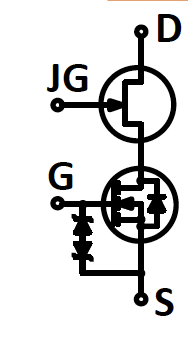
SiC Combo JFET

  • 2 chips in 1 package → Combo JFET
  • Separate access to MOSFET and JFET
    gates → better switching dV/dt control
  • Ultra low RDS(on), high pulse current
  • 1200 V, RDS(on) ≤ 10 mΩ
  • 750 V, RDS(on) … 5 mΩ – 10 mΩ
  • Target application: Solid state circuit
    breaker, disconnect switches

SiC JFETs 

onsemi offers SiC JFETs, SiC Cascode JFETs and SiC Combo JFETs, each type has its unique characteristics and is suitable to different applications. SiC JFET allows the SSCB to operate at up to 175°C, which is the material limit for an enclosure; SiC is able to withstand even higher temperatures.

Gen4 – 750 V
Gen4 – 750 V
Gen4 – 750 V
Screenshot 2025-07-23 at 93531 PM
TO-247 (4L)
Screenshot 2025-07-23 at 93502 PM
TOLL
Top Cool–TOLT
Screenshot 2025-07-23 at 93531 PM
TO-247 (4L)
Top Cool–TSOP
Screenshot 2025-07-23 at 93436 PM
D2PAK (7L)
JFET
NTBT004N075J4
4 mΩ
Combo-JFET
NTBT005N075SCBJ4
5 mΩ
Combo-JFET
UG4SC120009K4SH
9 mΩ
Combo-JFET

Why chose SiC JFET or Combo JFET 

Coolest operation

  • Lowest Power Loss
  • JFET Option: Normally ON or normally OFF

Smallest space

  • Minimal Part Count: Heat budget and paralleling
  • Stacked Chips: two chips in a single package, “Combo JFET”
  • Combined functions: On-chip temperature sensing
  • Combined functions: JFET or Combo JFET as current sensor

Dependable

  • Voltage rating: 750V provide the necessary safety margin
  • Rugged: dependable switching
  • Simple construction

Easy-To-Use

  • Simple drive method

Essential Guide for Engineers Developing Next-Gen Power Systems 

Explore onsemi’s latest System Solutions Guide for Solid State Circuit Breaker (SSCB) applications, supported by Richardson RFPD. Discover key products like onsemi’s SiC JFETs, offering superior performance over super junction MOSFETs. Tap into onsemi’s broad semiconductor portfolio and technical expertise for industrial, automotive, and energy infrastructure designs.

Why Solid-State Circuit Breakers? (SSCBs)

Free from the limitations of magnetic coils, semiconductor switches operate hundreds of times faster than electromechanical relays, interrupting current before it becomes hazardous. Without mechanical parts, semiconductor switches can perform unlimited connect/disconnect cycles without degradation. This innovative approach replaces traditional moving parts with semiconductors and advanced software algorithms, enabling faster interruption of extreme currents. Solid-state technology ensures extremely fast fault interruption, clearing faults in microseconds compared to milliseconds for mechanical circuit breakers of the same size. Wide bandgap (WBG) semiconductors offer superior material properties, allowing power devices to operate at higher voltages, temperatures, and switching rates.

Electro-Mechanical
Solid-State
Design
Contains moving parts and contacts
Uses Semiconductor as a switch
Speed
Milliseconds
Microseconds
Durability
Mechanical wear and tear
Durable
Precision
Limits are set by manufacturer
Offer precise control
Arcing
Yes
No
Power Dissipation
Lower efficiency
Higher efficiency
Power Dissipation
Yes
No

Solid-State Circuit Breakers v. Traditional Electromechanical Circuit Breakers 

There’s been a recent trend to replace traditional electromechanical circuit breakers with solid-state circuit breakers to protect expensive power electronics equipment. What are the differences between traditional and solid-state breakers? What system level benefits are gained converting to solid-state? What design resources are available to support engineers developing their own solid-state circuit breakers? These questions and more are answered in Richardson RFPD’s Tech Chat with onsemi on solid-state circuit breakers vs. traditional electromechanical circuit breakers.

Playlist

2 Videos

Energy & Power Design Support

Allow us an opportunity to assess your project and help bring your vision to market faster.

About our Team of Experts

Our team of global applications engineers are available to answer your questions to ensure your power conversion or energy storage system design meets your performance expectations. If you’re transitioning from silicon to gallium nitride (GaN) or silicon carbide (SiC), we’ll help identify the right switching device to achieve the power density and increased efficiency your application requires.